East Tennessee sits inside a humid subtropical climate zone where annual precipitation exceeds 50 inches, driving elevated soil saturation directly into residential foundations. Properties in historic districts like…
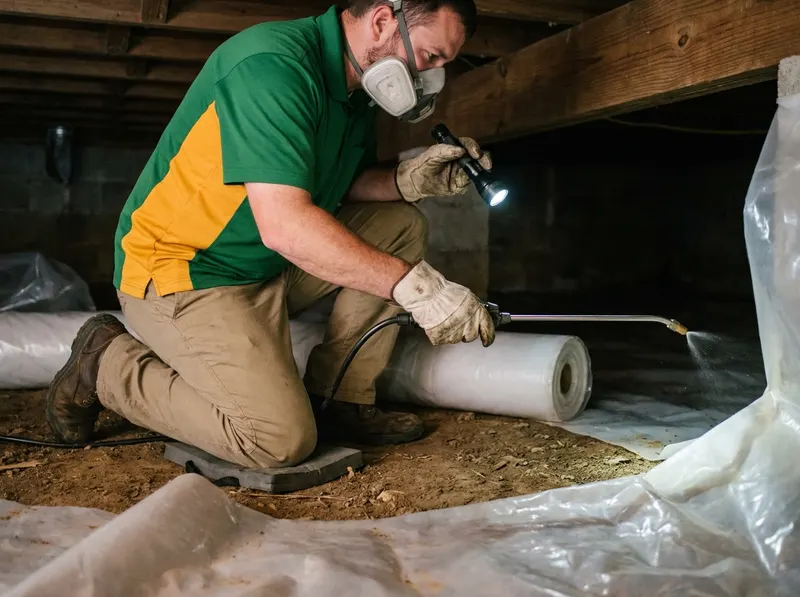
East Tennessee sits inside a humid subtropical climate zone where annual precipitation exceeds 50 inches, driving elevated soil saturation directly into residential foundations. Properties in historic districts like Fourth and Gill and Old North Knoxville frequently rest on stacked-stone or unsealed brick piers over exposed clay soil. Without a continuous vapor barrier, capillary action pulls ground moisture into uninsulated subfloor cavities, creating an ambient relative humidity that exceeds 70%. These microclimates soften yellow pine joists and attract wood-boring pests. Installing an anchored polyethylene ground barrier halts ground evaporation, protecting structural timber from wood decay fungus and subterranean termite colonization.
Substructure conditions vary sharply across Knox County topographies. Low-lying river basin parcels along Island Home Park and South Knoxville (SoKno) encounter perched water tables, whereas sloped lots in Sequoyah Hills and Bearden face subterranean hydro-pressure against concrete block perimeter walls. Crawlspace vapor and pest defense addresses these structural realities through physical isolation rather than broadcast chemical saturation. Foundation vents receive corrosion-resistant mesh to exclude rodents and larger insects, while load-bearing piers receive targeted borate applications. This treatment renders cellulose unpalatable to wood-destroying organisms without emitting airborne odors into the occupied living spaces above.
Homeowners weighing crawlspace vapor and pest defense typically evaluate basic retail ground plastic against complete encapsulation. Basic plastic laid loosely over soil stops simple evaporation but leaves foundation walls and floor joists unprotected against ambient summer humidity entering open vents. Full sealed encapsulation with active mechanical dehumidification regulates conditions completely, yet requires substantial continuous electrical operation and drainage modifications. Ground barrier defense with structural micro-treatments offers a pragmatic middle path: it stops ground evaporation and eliminates primary insect harborage zones, maintaining framing moisture content below the 19% threshold required for wood-decay fungi, while avoiding recurring machinery maintenance fees. In established subdivisions like West Hills, Fountain City, and Rocky Hill, this targeted approach preserves existing foundation ventilation while securing structural stability.
Every job gets a firm, written price after a free on-site visit.
Tell us about your crawlspace vapor and pest defense job in Knoxville and we'll send a clear, written quote, usually the same day.
 Norvian Pest Shield