Eastern subterranean termites require continuous contact with soil moisture to survive, entering crawlspaces and foundation walls through hairline masonry cracks as narrow as 0.8 millimeters. In older East Tennessee…
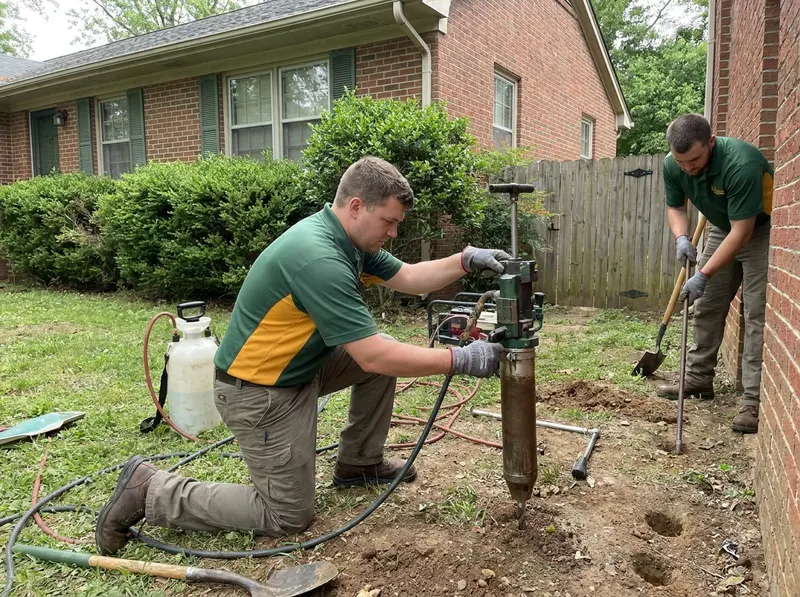
Eastern subterranean termites require continuous contact with soil moisture to survive, entering crawlspaces and foundation walls through hairline masonry cracks as narrow as 0.8 millimeters. In older East Tennessee homes throughout Fourth and Gill, Old North Knoxville, and Island Home Park, historic fieldstone foundations, stacked-brick piers, and direct wood-to-soil contacts create high-risk structural pathways. Conversely, concrete slab properties across West Hills, Bearden, and Rocky Hill face concealed incursions where utility conduits penetrate the concrete slab. Standard defensive treatment involves digging a 6-inch by 6-inch trench along foundation walls to apply non-repellent liquid termiticides, binding an undetectable lethal dose to the red clay soil that foraging worker termites transfer back to the subterranean colony queen.
Treatment selection balances immediate liquid soil barriers against slow-acting hexaflumuron or noviflumuron baiting stations. A continuous liquid soil perimeter establishes immediate lethal exclusion around masonry foundations, which fits homes with exposed crawlspace perimeter walls or active sill plate damage. The logistical trade-off involves invasive horizontal drilling through attached concrete slabs, such as patios and carports, at 12-inch intervals. Hexaflumuron baiting stations placed every 10 to 15 linear feet avoid concrete drilling and eliminate entire colonies through molt inhibition, but require 60 to 120 days to achieve full colony collapse during active feeding cycles. Sloped, heavily wooded properties near Ijams Nature Center, Sequoyah Hills, and the Tennessee Riverfront often encounter heavy exterior tree-root competition, where a combined application of targeted liquid entry-point barriers and exterior perimeter bait stations provides long-term suppression against dense forest colonies.
1. Technicians conduct a 360-degree foundation inspection, mapping moisture zones, mud shelter tubes, and crawlspace framing timbers. 2. A trench measuring 6 inches wide by 6 inches deep is excavated along exterior foundation walls, supplemented by mechanical sub-slab injection beneath adjoining exterior flatwork. 3. Crawlspace ground contact points, interior pier supports, and plumbing penetrations receive targeted low-pressure soil saturation to stop hidden moisture bridging. 4. Tamper-resistant baiting stations are placed flush with turf levels along the exterior drip line for continuous biological monitoring. 5. Annual visual re-inspections verify the chemical barrier remains uninterrupted by subsequent landscape grading or structural shifts.
Every job gets a firm, written price after a free on-site visit.
Tell us about your subterranean termite treatment job in Knoxville and we'll send a clear, written quote, usually the same day.
 Norvian Pest Shield