Rodent abatement stops the reproductive cycle of roof rats (Rattus rattus) and house mice (Mus musculus) before nesting habits ruin internal insulation or chew electrical wiring. While temporary retail poison baits…
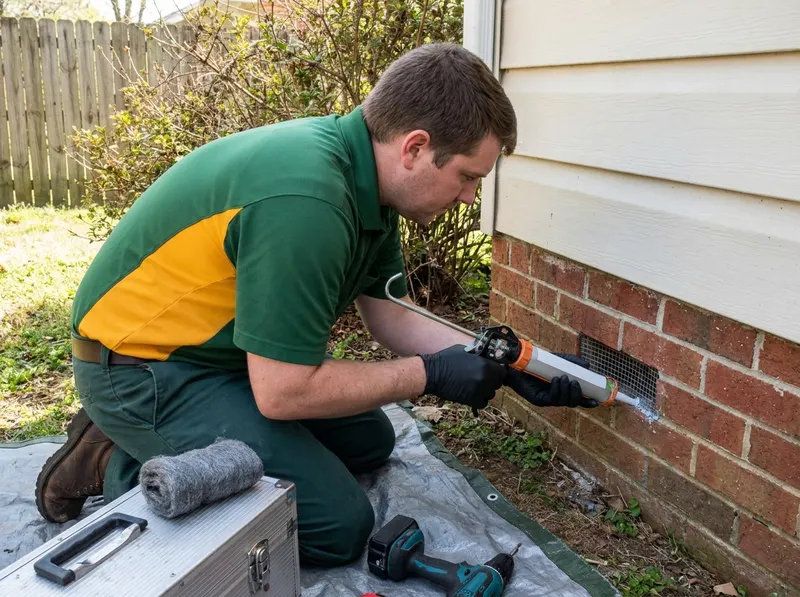
Rodent abatement stops the reproductive cycle of roof rats (Rattus rattus) and house mice (Mus musculus) before nesting habits ruin internal insulation or chew electrical wiring. While temporary retail poison baits leave carcasses to decompose within hidden crawlspaces and drywalls, structural exclusion creates a permanent architectural barrier. Field technicians seal crawlspace vents, HVAC line chases, plumbing penetrations, and roofline fascia boards with 19-gauge galvanized hardware cloth and metal-infused elastomeric caulking. Mice compress their skeletal systems through gaps measuring one-quarter inch wide, while adult rats access crawlspaces through half-inch openings around mortar joints or foundation footings.
Older architectural styles in Knoxville introduce distinct mechanical intrusion routes. Historic brick foundations in Fourth and Gill, stone basements in Old North Knoxville, and river-adjacent stone crawlspaces in Island Home Park frequently suffer mortar deterioration that permits Norway rats entry beneath sill plates. Mid-century ranch homes across West Hills and Bearden feature low-slope roofs with unsealed soffit returns, allowing tree-dwelling roof rats to jump from mature oak branches directly onto the decking. Modern walkout basements in Rocky Hill and wood-framed additions in South Knoxville often present unsealed openings where central air compressor conduit enters exterior siding.
Decision pathways balance mechanical barrier exclusion against routine chemical maintenance. If a home experiences recurring attic scratching during autumn cool-downs, physical exclusion provides the permanent solution by mechanically locking rodents out of the envelope. If a detached outbuilding lacks perimeter footings, continuous mechanical trapping combined with brush clearance serves as the realistic containment protocol. The core trade-off involves immediate structural investment versus repetitive annual poison applications that never address open entry voids.
Implementation proceeds through four sequential phases: 1. Complete attic, crawlspace, and foundation elevation inspection mapping active run tracks, droppings, and entry voids. 2. Exterior structural sealing applying hardware cloth, copper mesh, and silicone sealant across all sub-inch penetrations. 3. Interior mechanical snap trapping placed inside closed runs within attics and basements for complete population removal. 4. Sanitization and follow-up checks spaced seven to ten days apart until zero trap activity confirms total population abatement.
Every job gets a firm, written price after a free on-site visit.
Tell us about your rodent exclusion and abatement job in Knoxville and we'll send a clear, written quote, usually the same day.
 Norvian Pest Shield